Timberland is a serious asset class.
For too long, valuing rural and timber property has meant a broker's opinion, a handful of rough comparables, and a number that arrives without much explanation. At Made Out West, we built something different — because we believed our clients deserved analysis that could actually stand behind the number it produces.
TIMBERLOG[X] is that tool. It is our proprietary internal platform for timberland and rural property valuation, investment analysis, and portfolio reporting. This is an introduction to what it does, and why we built it.
The Problem With How Rural Land Gets Valued
Anyone who has transacted timberland in the Pacific Northwest knows how the process typically unfolds. You receive an opinion of value — sometimes a formal appraisal, more often a one-page summary — and you are expected to accept it largely on faith. The methodology is rarely explained. The assumptions are rarely stated.
This is not a criticism of individuals. It reflects a structural gap in how the rural land industry has historically operated.
Timberland is genuinely complex. Its value is a function of standing timber volume, species composition, log prices, logging costs, site productivity, terrain, harvest timing, land quality, access, zoning, and a dozen variables that interact in ways that a simple per-acre figure cannot capture.
When analysis gets compressed into a conversation and a comp sheet, critical value drivers get lost. The result is worse decisions — for sellers who leave value on the table, buyers who cannot price risk accurately, and investors who cannot underwrite with confidence because the underlying data simply is not there.
"The rural land industry has historically compressed a highly complex asset into a single dollar-per-acre figure and a handshake." CEO David Brinker Jr.
Why We Built TIMBERLOG[X]
Made Out West was founded on the belief that timberland transactions deserve the same analytical rigor applied to other institutional asset classes.
We operate in markets where individual deals routinely involve millions of dollars of timber value, complex harvest economics, and long investment horizons. The standard of analysis available to most buyers and sellers has not kept pace with what those stakes demand.
TIMBERLOG[X] is our answer to that gap. It is a structured analytical engine — built internally by our team — that allows us to work faster, more consistently, and at a level of depth that would otherwise require weeks of manual modeling.
It is not a replacement for professional judgment, field verification, or a qualified timber cruise. It is the framework that makes our judgment more rigorous.
What the Platform Does
At its core, TIMBERLOG[X] is a stand-level valuation model. It begins with individual timber stands — characterized by species, age, terrain, site productivity, and stocking — and builds a complete property-level picture from the ground up.
When cruise data is available, the platform incorporates actual measured volumes and projects them forward using yield-table growth curves calibrated to Pacific Northwest species. When no cruise exists, it generates modeled estimates from species-specific yield tables, adjusted for site conditions.
From there, the platform models net stumpage on a per-species basis — what timber is actually worth after logging costs, haul, road work, harvest taxes, and administration. It applies present-value discounting to pre-merchantable timber, reflecting the real economic difference between timber harvestable today and timber still a decade from rotation.
Land value, roads, improvements, income streams, hunting value, and development potential are each captured as distinct components — contributing to a total that is transparent, explainable, and defensible.
For investment analysis, TIMBERLOG[X] produces a full discounted cash flow model: projected harvest schedules, holding costs, residual land appreciation, IRR, and equity multiple. The same framework applied to institutional timberland funds, made accessible for the private market transactions that define most Oregon timberland activity.
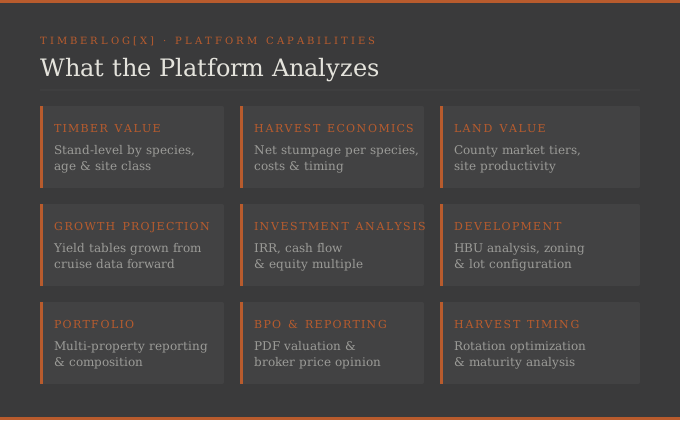
Platform capabilities include:
Stand-level timber valuation by species Harvest economics and net stumpage modeling Yield table growth projection from cruise data Land value by county market tier and site productivity Development potential and highest and best use analysis Investment IRR, cash flow, and equity multiple Broker Price Opinion generation Portfolio composition and multi-property PDF reporting Harvest timing optimization
What This Means for Our Clients
The practical benefit of this level of analysis is clarity.
When we present a valuation to a client — whether a landowner evaluating a sale, a buyer underwriting an acquisition, or an investor reviewing a portfolio — they receive more than a number. They receive an understanding of why the property is worth what it is worth, where value is concentrated, and which factors have the most leverage on the outcome.
For a seller, that might mean understanding that 80% of the property's value sits in one merchantable stand, and that log market timing has a meaningful impact on net proceeds at closing.
For a buyer, it means the ability to stress-test assumptions. What happens to returns if log prices soften 15%? What if the pre-merchantable stand takes five additional years to reach rotation?
For a portfolio owner, it means a consistent, comparable analytical framework across all holdings — rather than a collection of appraisals produced by different firms using different methodologies.
"They receive more than a number. They receive an understanding of why the property is worth what it's worth, where value is concentrated, and what factors matter most." Broker Lauren Read
Technology in the Service of Expertise
It is worth being clear about what TIMBERLOG[X] is not.
It is not an algorithm that replaces field knowledge. It cannot tell you that a stand has significant conk rot, that the access road will require reconstruction before logging, or that a corner of the property has been affected by windthrow. Those things require a forester on the ground and a broker who has walked the timber. No platform changes that.
What TIMBERLOG[X] does is give our team a structured framework for integrating field knowledge, market data, and financial modeling — in a way that is rigorous, repeatable, and transparent. The model is only as good as the inputs it receives, which is exactly why it is a tool used by professionals rather than a substitute for them.
A More Modern Approach to Land Brokerage
Made Out West was built on a straightforward conviction: that the landowners and investors we work with deserve a brokerage that operates at the same level of analytical sophistication as the assets they own.
Oregon timberland and Pacific Northwest rural property are serious assets. They require serious analysis.
TIMBERLOG[X] is part of how we deliver on that — an ongoing investment in the tools, methodology, and intellectual infrastructure that allow us to serve clients better. Not by replacing the judgment and relationships that define good brokerage, but by ensuring that judgment is always backed by the most rigorous analysis we can produce.
The firms that will lead the next generation of land brokerage are those that bring both local knowledge and institutional discipline to every engagement. That is what we are building at Made Out West.
If you are evaluating a timberland sale, acquisition, or portfolio and would like to understand how we approach the analysis, we would welcome the conversation.
For more info call 866-2-OUTWEST
TEAM MADE OUT WEST